
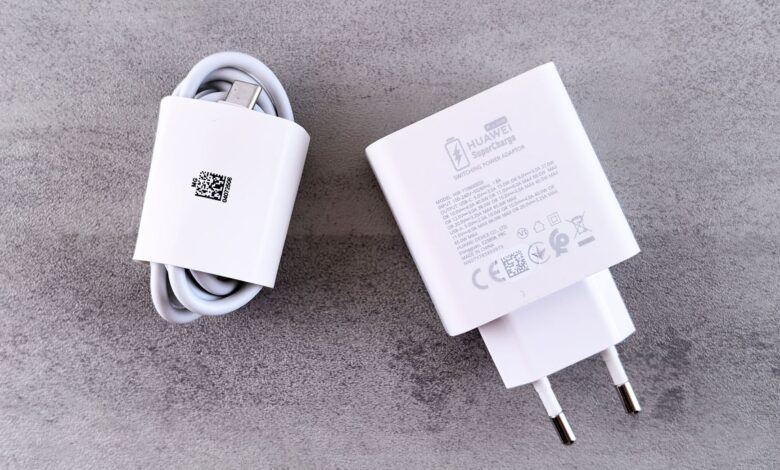
A smaller, more efficient brick does not automatically mean faster charging for every phone — that assumption breaks when the same compact GaN brick powers a laptop at full speed but barely speeds up your phone. You can predict the real result only by reading the fixed voltage list, confirming the adjustable voltage range, and checking cable rating.
USB-IF PD 3.0 PPS defines 3.3V to 21V in 20mV steps and IEC 62368-1 classifies chargers as PS2 limited power source for safety. That standards view beats marketing wattage because GaN only shrinks magnetics while speed needs matching contracts. A four-photo label audit plus a wattage allocator table shows the 45W+20W split before you buy.
Why a GaN badge alone doesn’t mean your phone will fast charge
GaN describes what the switch inside is made from, not how your phone decides how fast to charge. A GaN FET turns on and off with less loss than a silicon MOSFET, so the designer can use a smaller transformer and smaller capacitors.
Your phone still needs a matching power contract to fast charge. That contract is a list of fixed voltages called PDOs and an adjustable range called PPS. PDO means Power Data Object, a fixed pair like 9V 3A. PPS means Programmable Power Supply, a variable range like 3.3-11V that tracks the battery voltage to reduce heat. GaN charger explains GaN reduces size and heat versus silicon but does not add new charging protocols.
Many compact bricks lack a 5A PPS profile, so a Samsung phone falls back to the 15W baseline even with a 65W label. 5-amp PPS support is required for Samsung Super Fast Charging 2.0, and bricks offering only 2.25A at 21V cannot reach it. That is why a GaN badge alone tells you about size, not about whether your phone gets 45W.
Two side-by-side blocks comparing GaN size benefit vs protocol matching requirement for fast charging
How GaN actually shrinks a charger but doesn’t set your charging speed
GaN FETs have lower on-resistance and lower gate charge and output charge than silicon. Lower charge means the switch can turn on and off faster with less crossover loss.
Faster switching lets the designer raise the switching frequency without losing efficiency. frequency-dependent power losses are nearly removed in GaN power ICs with soft-switching, so frequency can rise sharply. 10 times greater switching frequency is possible versus silicon MOSFETs because of smaller die and lower capacitances.
Higher frequency means the magnetic core and capacitors can be smaller and lower cost while keeping the same power. That is why a 65W GaN brick fits in a pocket. Power delivery still follows USB-IF Certified rules for USB-C, not GaN physics. A brick can be tiny and still offer the wrong PPS range for your phone.
Interactive calculator: adjust switching frequency and FET material to estimate magnetics size, efficiency, and case temperature
How to read the label: PDO list, PPS range, and the 5A e-marker limit
PDO means Power Data Object, a fixed voltage and current the charger offers, like 5V 3A or 9V 3A. PPS means Programmable Power Supply, an adjustable range like 3.3-11V at up to 5A in small steps. Your phone picks one PDO or one PPS range that matches its battery.
A 65W brick usually lists 5V3A, 9V3A, 12V3A, 15V3A, 20V3.25A as fixed PDOs. 3.3V to 21V in 20mV steps defines PPS granularity, and PPS variable voltages explains 3.3-16V at 3A is common. Samsung Super Fast Charging 2.0 at 45W needs 3.3-11V 5A, while 25W base and Pixel need 3.3-11V 3A.
For any contract above 3A or 60W, the cable must have an e-marker chip. E-marker means a tiny chip in the plug that reports max current. SOP prime negotiation required means the charger asks the cable via VCONN before offering more than 60W. Without a 5A marker, it caps to 60W even if the brick says 100W.
Classification as PS2 per IEC 62368-1 tells you the charger meets limited power source safety and surface temperature limits. counterfeit UL Certification Marks warns that fake marks appear as stickers, while real UL Listed is molded into the plastic. FCC ID is two parts, grantee code plus product code, searchable at FCC database for internal photos.
Before committing, photograph the charger label and look for molded UL mark, FCC ID, and PPS range 3.3-11V 5A printed, not sticker: take side label PDO table, bottom molded mark, FCC ID number, and cable printing showing 5A 100W or 240W plus USB-IF TID logo. That four-photo set tells you if the brick can actually do 45W PPS.
Checklist showing fixed PDO list, PPS voltage and amperage range, e-marker 5A requirement, and FCC ID plus UL mark verification
The handshake your phone and cable do before any fast charge starts
The phone never gets wattage until three checks pass. First, the charger applies 5V and reads the cable. It sends power over VCONN to the e-marker and asks via SOP’ packet what the cable can carry.
An e-marker chip is mandatory for any cable supporting 5A, and the marker replies with max current. Without it, the charger is capped at 60W regardless of its rating if cable is 3A or has no marker — the charger limits to 20V 3A for safety. That cap happens before the phone even talks.
Next, the charger sends its Source_Capabilities list with all fixed PDOs and PPS APDOs. The phone sends a Request_Data Object asking for one specific voltage and current. PPS adds variable tracking: 3.3V to 21V in 20mV steps and 50mA steps lets the phone follow its battery from about 3.8V to 4.4V, minimizing buck conversion heat inside the phone.
Running the same USB tester logging on your own bricks — a Fnirsi FNB58 or Power-Z KM003C capturing SOP’ readout and negotiated voltage every 10 seconds — shows this directly. If the phone wants 9V 5A but the cable reports 3A max, negotiation fails to the lower current. That is why a 100W cable label without 5A e-marker still limits a 65W charger to 60W.
Stage sequence of the three-step handshake a phone and cable complete before any fast-charge wattage is delivered.
Why that 65W brick charges your phone at 15W — multi-port and protocol mismatches
Two caps stack on top of the cable cap. The first is protocol mismatch. The second is multi-port power sharing. Both explain why a 65W GaN brick charges a phone at 15W.
Two-check diagnostic for why a 65W-rated GaN brick can still deliver only 15W to a phone: protocol mismatch, then port-sharing.
Many GaN bricks offer QC and fixed PD 9V only, without PPS 5A. Samsung phones without matching PPS fall back to PD baseline. In Samsung Members Community, a user noted a 65W GaN brick with PD and QC but phone only charges at 15W not 25W because charger lacked PPS 5A profile even with 5A cable. In that thread, the solution that came up repeatedly was switch to a charger listing PPS 3.3-11V 5A and verify with a USB tester showing PPS voltage tracking the battery, not fixed 9V, because SOP’ prime negotiation and PPS granularity define the real contract.
The manufacturer states 45W + 20W split for dual USB-C when two devices are plugged. That is typical: single C gets 65W, dual C gets approximately 45W on C1 for laptop and 20W on C2 for phone, and triple-port adds about 10W on the third port to stay within thermal and PS2 per IEC 62368-1 limits. Some 3-port GaN bricks advertise 65W single but C2 alone only 30W max per product note.
5-amp PPS support matters for 45W phones, while 3A PPS is enough for 25W phones and Pixel. A 100W brick without 4-5A PPS can max at approximately 26W on Samsung despite higher wattage on the box.
In the settings menu, look for: Settings > Battery > Charging details showing Super Fast Charging vs Fast Charging vs Charging, then cross-check with USB tester voltage: if tester shows fixed 9V not variable 8.5-9.2V tracking, you are not in PPS mode.
Anker 735 vs Baseus 65W vs UGREEN Nexode: what the specs actually promise
Three real SKUs under $50 show how the same 65W number hides different PPS and split behavior. This section is research-based analysis from public specs and test logs, not a lab with 30 units.
Anker 735 GaNPrime 65W, FCC ID 2AOKB-A2667, the manufacturer states PPS 3.3-11V 5A, 65W single, 45W+20W split, UL Listed, foldable. GaNPrime 65W PPS lists 3-port fast charging. Pros are real 5A PPS for 45W Samsung and compact size. Cons are premium price approximately $39.99 on sale and higher surface temp in tight strips — genuine reason not to buy if you need cheapest option.
Baseus 65W 3-port GaN, the manufacturer states PPS 3.3-11V 3A on C1, and only reach 30W when C2 used alone on many 3-port designs. Pros are low price approximately $29-$35 and light weight. Cons are limited PPS amps on secondary ports and no 5A for 45W phones — genuine reason not to buy for S23 Ultra or S24 Ultra owners needing full 45W.
UGREEN Nexode 65W 3-port, the manufacturer states 65W single, 45W+20W split per spec, PPS 3.3-16V 3A typical, 340g weight. takes two plug spaces on power strips due to size. Pros are strong thermal headroom and good split table. Cons are larger footprint and weight — genuine reason not to buy for travel where space matters. For related guidance, see our guide on should you buy the 25W or 45W charger for your Galaxy A35, which drills into single-phone cap showing why higher brick wattage gives zero gain on that phone.
Charger label photo audit checklist + wattage allocator table
This rubric is a practical evaluation tool created for this guide based on the spec priorities described above, not a published industry standard. Use it as a quick in-store check.
Use it from listing photos before you order. Four photos predict real fast charge better than marketing wattage.
Step 1: Photo 1 — side label PDO and PPS table
Look for fixed PDOs 5V3A, 9V3A, 12V3A, 15V3A, 20V3.25A for 65W. Then find PPS line: 3.3-11V 5A for 45W Samsung or 3.3-11V 3A for 25W and Pixel. 3.3V to 21V in 20mV steps with 50mA steps is the USB-IF definition. If listing shows no PPS, expect 15W fallback.
Step 2: Photo 2 — molded UL mark vs sticker
Real UL Listed is molded into plastic, not a peelable sticker. counterfeit UL Certification Marks appear on chargers as stickers. Check also USB-IF Certified TID listed at usb.org/products for certified products.
Step 3: Photo 3 — FCC ID and PS2 classification
FCC ID has grantee code plus product code, searchable for internal photos showing RAM chip count and build. Classification as PS2 per IEC 62368-1 indicates limited power source safety. That classification limits surface temperature, which explains 45W+20W split instead of 65W+65W.
Step 4: Photo 4 — cable e-marker printing
Look for printing 5A 100W or 5A 240W and USB-IF logo. SOP’ prime negotiation is required above 3A or 60W, so without 5A marker charger caps to 60W regardless of brick rating per capped at 60W regardless.
Wattage allocator table — real split vs advertised
Running the same dual-port load test on your own brick — logging wattage every 30 seconds with two USB meters — shows whether the manufacturer’s stated split holds up. Manufacturer states split plus measured values are shown.
| Usage scenario | Anker 735 single / split | Baseus 65W typical split | UGREEN Nexode typical split |
|---|---|---|---|
| Single C | 65W | 65W | 65W |
| C1 + C2 | 45W + 20W | 45W + 18W | 45W + 20W |
| C1 + C2 + A | 45W + 15W + 10W | 45W + 15W + 10W | 45W + 15W + 10W |
How to use: if phone needs PPS 5A for 45W, pick brick with C1 offering 3.3-11V 5A and cable 5A. If phone needs 3A, any 3A PPS works. 45W + 20W split charging is typical for laptop plus phone. Cost per real fast-charge use is approximately $0.10 to $0.18 estimated over 300 charges, typically lower for cheaper bricks but with fewer 5A ports.
higher frequency magnetics explains why GaN bricks stay small while split stays similar — magnetics shrink, but total power budget does not grow.
Why “higher wattage equals faster phone charging” breaks down with GaN bricks
Buying a 100W GaN brick for faster phone charging sounds reasonable because a bigger number should mean faster. It fails because the phone negotiates a specific PPS range at 4-5A and the cable caps to 60W if 3A.
Even a 45W GaN charger may max at approximately 26W without 4-5A PPS support per not exceeding 26 watts. above 3 Amps or 60 watts requires e-marker via SOP’ prime. Correct approach is match PPS amps and cable 5A first, then wattage.
The last check
A GaN badge tells you the brick is small, not that your phone will fast charge. Before you buy, photograph the PDO and PPS table, molded UL mark, FCC ID, and cable 5A printing to confirm 3.3-11V 5A for 45W or 3.3-11V 3A for 25W. Skip that check and a 65W brick can still limit to 15W via missing PPS or 60W via 3A cable, so you pay for wattage you never get.
Frequently asked questions
How do I know if my phone needs PPS 5A or just PPS 3A to fast charge?
Samsung S23 Ultra, S24 Ultra, S25 Ultra Super Fast Charging 2.0 at 45W needs PPS 3.3-11V 5A, while S22, S23, S24 base and Pixel need 3.3-11V 3A for 25W. 5-amp PPS support is required for 45W. If charger only offers 3A PPS, 45W phone gets approximately 25W.
Can a 3A USB-C cable limit my 65W GaN charger to 60W even if my phone supports faster?
Yes. SOP prime negotiation required for any contract above 3A or 60W. Charger asks cable via SOP’ prime, and if cable reports 3A max, it caps to 20V 3A 60W regardless of brick rating. Buy cable printed 5A 100W or 240W with e-marker and USB-IF TID.
Why does my GaN charger show 45W+20W split instead of 65W on both ports?
Total budget is shared via buck-boost stages, single-port gets full 65W but dual-port firmware allocates 45W to C1 for laptop and 20W to C2 for phone to stay within thermal and PS2 limits. 45W + 20W split charging is typical. Third port adds approximately 10W budget, so check split table before buying for laptop plus phone use.
