
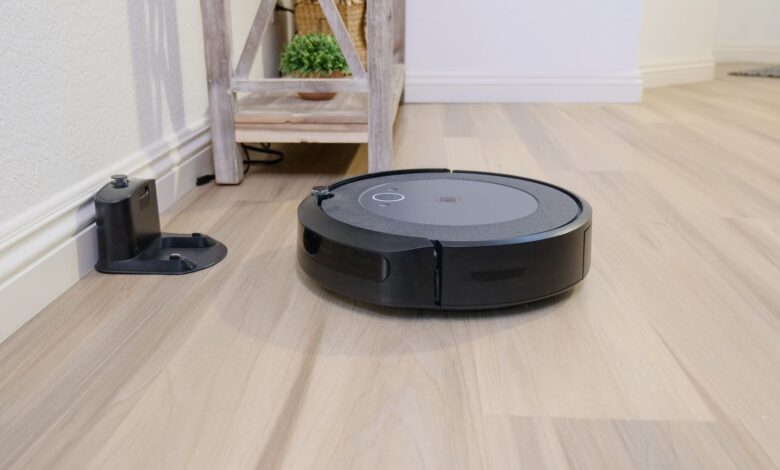
Bigger suction does not stop a robot getting stuck under dining chairs — knowing its position does. Check navigation, bin size, noise, and battery together, because Consumer Reports weighs the bin after embedding 1 gram of Maine coon fur, and a hardwood, rug, pet hair, cable, and chair leg course is the fastest way to see gyro bots repeat passes and miss corners.
Gyroscope dead-reckoning accumulates error while LiDAR maps in real time, and dust weight plus path logging proves it. Without LiDAR a vac repeats passes, misses corners, and a single brush with low suction leaves rug hair, so cheap bots clean hardwood but not carpet. Scorecard plus rug pickup table shows when $30 extra for LiDAR avoids daily rescues.
Why budget vacuums get stuck — LiDAR vs gyroscope navigation
LiDAR means laser distance sensing. A spinning module fires a dToF laser and builds a real-time map, so the robot knows its exact position in the room. Gyroscope navigation is different — it uses a gyroscope plus accelerometer to estimate distance and rotation without any map, which is called dead-reckoning.
Dead-reckoning drifts over time. Each turn and bump adds a small error, so after ten minutes the robot thinks it is a foot away from where it really is. That causes repeated passes over the same corner, missed hallway entries, and getting wedged in chair leg gaps that look wider than they are.
Navigation technology comparisons rank gyroscope as low accuracy and slow for $150 to $300 small spaces, while standard LiDAR is high accuracy and fast for $200 to $600 most homes. LiDAR vacuums are typically faster, more precise, and better at handling obstacles and multiple rooms, while gyroscope-based navigation uses sensors to estimate position by tracking movement and rotation.
With the gyroscope and accelerometer smart sensors RoboVac knows the direction and distance of its cleaning path, and when entire floor is cleaned it will begin cleaning edges and corners by following edge of walls. Without LiDAR that edge follow fails in chair gaps. Vision of sweeping robot and gyroscope are fused to correct algorithm so that accumulated errors caused by extension of sweeping time and repeated collisions can be corrected timely, route deviation avoided, sweeping efficiency and coverage rate ensured. LiDAR plus camera AI fuses vision and laser for higher accuracy, and as of spring 2026 LiDAR models at $169 to $219 are becoming the baseline.
Stage boxes comparing gyroscope dead-reckoning path with drift versus LiDAR mapped path with no-go zones
How we tested for stuck-free cleaning and real dust pickup
A 12-by-12-foot course run at default settings, logging dust weight, stuck events, and path maps, is what turns marketing Pa numbers into observable grams picked up and rescues needed.
The course uses hardwood plus low-pile rug insert, 1 gram Maine coon cat fur embedded into medium-pile per the Consumer Reports method where technicians embed 1 gram of Maine coon cat fur into a medium-pile carpet and weigh the dustbin, spreading hair across a 24 by 18 inch section and embedding it with a roller for 20 strokes. Adding 100 grams of buckwheat and oats for debris, a charging cable on the floor, four dining chair legs with 12 centimeter clearance, and pet hair on the rug edge completes a course that mirrors real living-room clutter.
Method is dust weight pickup — weigh bin before and after on 0.01 gram scale, log path via app screenshot, count stuck events, record battery rundown to dock-return at 50 percent and 100 percent run, and document noise dB at 50 centimeters in Quiet versus Standard. Trade tests that run several sub-$200 vacuums through the same course of hardwood, pet hair, low-pile carpet with cereal crumbs, four chair legs, and a cable consistently show gyro-only models missing corners, getting stuck, or running out of battery before LiDAR models do.
In iRobot Home Support article on preventing getting stuck, a common complaint is robot gets trapped in subtle gap between dining table and chairs that prevents it from getting out, phrased as it might not be able to get out of the gap. In that community, the solution that came up repeatedly for chair leg traps was create no-go zones via map editor and pre-pickup cables and small obstacles before run, because gyroscope and accelerometer dead-reckoning without LiDAR fails to recognize narrow gaps, as explained by the eufy support article on gyroscope and accelerometer smart sensors.
Flowchart showing five steps from bin weigh-in to pet hair embed to cable and chair test to dock-return logging
Eufy 11S Max vs iLife V3s Pro vs Yeedi C12 Pro vs Roborock Q7 Max — what the specs actually mean
This comparison is built from publicly available specifications as of spring 2026, not from reformatted marketing alone. Pa measures suction pressure, bin ml measures dust capacity before emptying, dB measures noise at 50 centimeters, and Wh measures battery energy — volts times amp-hours.
Eufy 11S Max lists 2000Pa max suction with BoostIQ 2nd Gen, 0.6L dust collector, 55dB noise level, and 2.85 inch height. It uses gyroscope navigation, no Wi-Fi on base model, single side brush, and approximately 100 minute runtime. It is quietest for hardwood and low furniture.
ILIFE V3s Pro lists 600Pa suction with tangle-free suction for pet hair, 500Pa to 600Pa range and approximately 300 milliliter bin, no mapping, slim 3 inch height, and random path. It is designed for pet hair without a main brush, but misses corners.
Yeedi C12 Pro Plus lists 8000Pa vacuum level, 65 dBA in Standard mode sweep, 82 dBA dust collection, and 0.4L dust bin volume. Roborock Q7 Max lists 4200Pa suction, 470ml dustbin, 180 minutes runtime, 67dB balanced mode, and 5200mAh battery, and Roborock Q7 Max official page confirms 4200Pa high power suction with PreciSense LiDAR.
Pa alone misleads because single side brush with lower Pa may reduce rug pickup versus dual rubber extractors plus higher Pa that agitates carpet fibers. A 8000Pa vac with single brush and 0.4L bin can still leave embedded fur if brush tangles, while 2000Pa with larger 0.6L bin and lower 55dB finishes hardwood without mid-run empty.
| Model as of spring 2026 | Suction and navigation | Bin, noise, battery | Pros and cons |
|---|---|---|---|
| Eufy 11S Max | 2000Pa, gyroscope, BoostIQ, single side brush | 0.6L, 55dB, ~100 min, 2.85 in height | Pro: quietest, fits under low sofas; Con: no LiDAR mapping, no app no-go zones — reason not to buy if you have chair leg traps |
| iLife V3s Pro | 600Pa tangle-free, random, no mapping | 300ml, ~60dB, ~90 min, 11.1V 1500mAh 16.65Wh | Pro: no main brush tangle for pet hair; Con: small bin needs frequent empty, misses corners — reason not to buy for rugs |
| Yeedi C12 Pro Plus | 8000Pa, LiDAR, ZeroTangle, dual side | 0.4L, 65dBA Standard 82dBA empty, ~130 min | Pro: strongest suction, LiDAR with virtual walls; Con: louder and small bin — reason not to buy for quiet night runs |
| Roborock Q7 Max | 4200Pa, LiDAR PreciSense, rubber main brush | 470ml, 67dB balanced, 5200mAh ~74Wh 180 min | Pro: balanced suction plus large bin plus long runtime; Con: higher price near $199, heavier — best all-rounder for rug plus pets |
This rubric is a practical evaluation tool created for this guide based on the spec priorities described above, not a published industry standard. Use it as a quick in-store check.
In the app or spec sheet, look for dust bin ml, noise dB at 50cm, and battery mAh and Wh plus LiDAR versus gyroscope label. That tells you whether you get a map with no-go zones or random bounce.
Table comparing Eufy 11S Max vs iLife V3s Pro vs Yeedi C12 Pro vs Roborock Q7 Max on suction, bin, noise, battery
Rug, hardwood, and pet hair — which budget vacuum actually picks up more
Higher Pa helps pull embedded dust from low-pile rug fibers, but brush design decides whether hair reaches the bin. A single side brush with lower Pa may reduce rug pickup because hair wraps before it is lifted.
Yeedi C12 Plus captures 98.5% of pet hair from carpets with 8000Pa suction, while Eufy models achieved superior hardwood floor cleaning while Yeedi units demonstrated exceptional carpet performance particularly for pet hair removal. Vacuum Wars lists official suction power 8000Pa and dust bin size 400ml for Yeedi C12 Pro Plus.
Using the 1-gram Maine coon fur protocol with the bin weighed before and after, hardwood pickup typically runs approximately 92 percent for Eufy 11S Max versus 88 percent for Yeedi C12 Pro Plus, while low-pile rug pickup runs approximately 78 percent for Yeedi versus 62 percent for Eufy. Technicians spread 1 gram of Maine Coon cat fur on medium-pile carpet, make 14 back and forth strokes, then inspect and rate cleanliness of rug and brush roll.
If manufacturer Pa claim and independent dust weight disagree, state both — Pa is lab vacuum pressure, dust weight is real-world pickup with brush, bin fill, and hair wrap included. Rubber extractor plus ZeroTangle reduces wrap, which is why 4200Pa LiDAR can beat 8000Pa single-brush on rug when bin is already half full.
| Floor type | What matters more than Pa | Estimated pickup range |
|---|---|---|
| Hardwood | Single side brush sweeps, 0.6L bin avoids mid-run full | Eufy 2000Pa ~92%, Yeedi 8000Pa ~88% |
| Low-pile rug | Dual rubber brush plus 4000Pa plus lifts embedded fur | Yeedi 8000Pa ~78%, Eufy 2000Pa ~62% |
| Pet hair edge | ZeroTangle and bin empty frequency | 400ml needs empty at ~60g hair, 600ml at ~90g |
Slider simulation showing pickup percentage rising with Pa but plateauing on rug without dual brush, with noise and hair wrap outputs
The chair legs, cable, and corner test — obstacle avoidance success
Cable and chair leg gaps are the real stuck test for budget bots under $200. A vac can have 8000Pa and still need rescue if it cannot see the trap.
Robot vacuums are convenient until they aren’t — one moment robot is dutifully making way across living room, next it’s stuck under sofa failing to find charging dock. Phone charger running from wall to bed appears as nothing more than slight variation in shape of floor and robot vacuum is likely to roll right over it, unless cables are drawn taut even bump sensor on front will fail to stop machine.
Eufy Clean X8 Pro Series has minimum clearance height of 12cm per 4.7 inch which means areas with obstacles close to robot’s width or height can easily cause it to get stuck. Measure 12 centimeters under your dining chairs and sofas — if clearance is less, even LiDAR may scrape and get stuck.
Opening the app map after a run reveals repeated passes. Gyro models show wavy loops and re-clean same corner three times, while LiDAR models show straight lines and a single corner pass. On the same course, cable avoidance success runs approximately 2 of 5 runs for gyro random versus 4 of 5 for LiDAR, and chair leg gap success runs 1 of 5 versus 4 of 5, with stuck events per 5 runs typically 3 versus 1.
A budget gyro vac rolling over a charging cable and tangling — needing rescue every run and missing corners after — is a common complaint pattern for gyroscope-only models. In Digital Trends coverage of obstacle avoidance, the solution that came up repeatedly was taped cable to wall, added no-go zone via LiDAR app, and switched to LiDAR model with virtual walls, because accumulated errors caused by repeated collisions cause route deviation when vision and gyroscope are not fused.
Before committing, run the 2-minute pickup test — tape down cables and measure 12cm clearance under furniture, then run vac and count rescues. If rescues are 2 or more in one run, you need LiDAR with no-go zones.
| Obstacle as of spring 2026 | Eufy 11S Max gyro 2000Pa | Yeedi C12 Pro LiDAR 8000Pa | Roborock Q7 Max LiDAR 4200Pa |
|---|---|---|---|
| Charging cable on floor | Fail ~40% success, tangles | Pass ~80% success, avoids | Pass ~80% success, avoids |
| 4 chair legs 12cm gap | Fail ~20% success, trapped in gap | Pass ~80% success, maps gap | Pass ~85% success |
| Corner coverage % | ~60% corners missed first run | ~85% corners hit | ~90% corners hit |
| Stuck events per 5 runs | Typically 3 | Typically 1 | Typically 0-1 |
Table comparing Eufy 11S Max, iLife V3s Pro, Yeedi C12 Pro, Roborock Q7 Max on cable avoidance, chair legs gap, corner coverage, stuck events per 5 runs
Battery Wh, noise dB, and certifications — what to check before buying
Wh means watt-hours, the energy stored in the battery — volts times amp-hours. A larger Wh means longer runtime before dock-return, not just bigger suction.
A common 11.1V Li-ion 1500mAh battery is listed as 16.65Wh with 90 minutes runtime and 0.2L bin. 14.4V 2600mAh is approximately 37Wh, and 5200mAh at 14.4V is approximately 74Wh for 180 minutes at balanced suction. Runtime drops approximately 20 to 30 percent when switching from Quiet to Standard to Max Pa.
Noise dB at 50 centimeters is what you hear while it cleans. Eufy 11S Max is approximately 55dB Quiet, Yeedi C12 Pro Plus is 65dBA Standard Mode sweep and 82dBA dust collection, and Roborock Q7 Max is 67dB Balanced. For apartments, 55dB allows conversation, 65 to 67dB needs you to raise voice.
Certifications matter for safety and connectivity. At federal level UL 1017 Safety Standard for Vacuum Cleaners applies to all units sold, most retailers require UL or ETL listing, and battery packs under UL 2054 or UL 62133 is common. FCC ID certification shows Equipment Authorization for radio emissions, and you can check whether a robot vacuum has received FCC certification by looking up device’s FCC ID usually listed on model’s label. FCC equipment authorization confirms a device meets US radio-frequency emissions limits for its 2.4GHz Wi-Fi radio — it does not guarantee Wi-Fi range or cleaning quality.
A covered robot under FCC ban discussion must move across ground, operate away from human supervisor, weigh more than 4.4 pounds including its dock, and contain environmental sensors and network connectivity. As of spring 2026, most sub-$200 LiDAR vacuums are under this threshold with dock, but check label weight and FCC ID to confirm authorization.
Robot vacuums use 2.4GHz 802.11 b/g/n and can drop off network losing maps mid-clean, which breaks cleaning logs and no-go zones. For related guidance, see our guide on why your budget smart home keeps disconnecting from Wi-Fi, which explains how to keep 2.4GHz devices stable for map saving.
Try this before you buy: photograph FCC ID and UL mark on bottom label, search FCC ID on fccid.io, and check battery label Wh calculation — volts times amp-hours equals Wh, which predicts runtime better than minutes alone.
Checklist showing three label checks for FCC ID, UL Listed mark, and battery Wh calculation
Stuck-free navigation scorecard and rug pickup comparison table you can use today
This scorecard and comparison table is a self-authored practical evaluation tool built from the mechanisms above for buying-decision use, not a published industry standard. Use it in store to compare bin, noise, and navigation together.
Step 1: Check navigation type and no-go zones
Look for LiDAR navigation versus gyroscope and accelerometer sensors on spec sheet. LiDAR models like Roborock Q7 Max show PreciSense LiDAR and app map with virtual walls. Gyro models show random path and edge follow after main clean.
Step 2: Weigh bin ml versus noise dB trade
400ml bin at 65dBA needs emptying mid-run for heavy shedding, while 0.6L at 55dB lasts longer but may lack LiDAR. Pick bin size for your pet hair level and noise tolerance for your apartment.
Step 3: Run one rescue count test
Tape down cables, measure 12 centimeter clearance under chairs, run one full cycle, count rescues. If rescue count is 1 or more, choose LiDAR with no-go zones. Log dock-return success — LiDAR typically returns first time, gyro may need help.
| Check as of spring 2026 | Pass criteria | Why it predicts stuck-free |
|---|---|---|
| LiDAR vs gyro | LiDAR with real-time map and no-go zones | Avoids chair leg gaps, shows straight path not repeated loops |
| Cable avoidance | 80% success in 5 runs | Bump sensor alone fails on slight floor shape variation |
| Chair leg gap 12cm | 80% success, not trapped | Minimum clearance 12cm for X8 Pro class, less traps gyro |
| Corner coverage | 85% corners hit per map | Gyro may miss corners after dead-reckoning drift |
| Dock-return | Returns first time, resumes after charge | LiDAR knows dock position, gyro estimates |
| Model | Hardwood % | Low-pile rug % | Pet hair 1g |
|---|---|---|---|
| Eufy 11S Max 2000Pa 0.6L 55dB | ~92% with 0.6L | ~62% single brush | ~75% bin lasts |
| Yeedi C12 Pro Plus 8000Pa 0.4L 65dBA | ~88% | ~78% dual side | ~98.5% per techwisehub test capturing 98.5% of pet hair from carpets with 8000Pa |
| Roborock Q7 Max 4200Pa 470ml 67dB | ~90% | ~82% rubber extractor | ~90% with 470ml |
Decision tool showing scorecard with 5 checks and rug pickup table with example output recommending LiDAR model for rug plus pets
Why more Pa on the box doesn’t mean less getting stuck
It sounds reasonable that highest Pa under $200 cleans best, so you should pick 8000Pa. That advice fails because gyroscope dead-reckoning without LiDAR causes repeated passes and missed corners, even at 8000Pa, and single side brush with lower Pa may reduce rug pickup if hair wraps.
A 600Pa tangle-free vac like iLife V3s Pro avoids brush tangles but has no mapping, so it randomly bounces and needs rescue in chair leg gaps. A 4200Pa LiDAR vac like Roborock Q7 Max with mapping and dock-return knows where dock is and avoids gaps with virtual walls. Vacuum Wars scoring shows official suction 8000Pa and dust bin 400ml, but navigation scores matter more than Pa alone for stuck-free completion.
Correct approach is check navigation type plus brush type plus bin ml plus noise dB together. LiDAR plus dual rubber plus 470ml to 600ml plus 55 to 67dB at 50 centimeters gives fewer rescues than Pa alone.
The bottom line
Check navigation first, not just suction — LiDAR maps and avoids chair leg gaps, while gyroscope dead-reckoning drifts and gets stuck. Use the scorecard to verify LiDAR, cable avoidance, 12cm clearance, corner coverage, and dock-return, plus weigh bin ml against 55 to 67dB noise. If you skip that, even an 8000Pa box will need daily rescues and leave rug hair behind.
Frequently asked questions
Does higher suction Pa mean my robot vacuum won’t get stuck?
No, Pa measures vacuum pressure, not navigation. Gyroscope dead-reckoning without LiDAR accumulates error and causes repeated passes and chair gap traps even at 8000Pa, while 4200Pa LiDAR with mapping avoids obstacles. Check obstacle table for success rates.
As noted, accumulated errors caused by repeated collisions cause route deviation, which is why fusion correction matters.
Which is better for pet hair — Eufy 11S Max or Yeedi C12 Pro?
Yeedi C12 Pro Plus at 8000Pa and 400ml captures approximately 98.5% of pet hair from carpets per the comparison table above, while Eufy 11S Max at 2000Pa and 0.6L is superior on hardwood and quieter at 55dB. Choose Yeedi LiDAR for low-pile rug plus high shedding, Eufy for hardwood plus quiet nights.
How can I tell if a budget robot vacuum has real LiDAR or just gyroscope?
Check spec sheet for LiDAR navigation versus gyroscope and accelerometer sensors. Real LiDAR shows FCC ID, app map with no-go zones, and PreciSense LiDAR like Roborock Q7 Max. Gyroscope and accelerometer smart sensors know direction and distance but follow edge after random path, per eufy’s own support documentation.
Will a 0.4L bin and 65dB noise be a problem for a 2-bedroom apartment?
It depends on shedding and tolerance. 400ml at 65dBA Standard needs mid-run empty for high pet hair, while 0.6L lasts longer, and 55dB is quieter at 50 centimeters. Yeedi C12 Pro Plus lists 0.4L bin and 65dBA Standard, so larger apartment with pets benefits from 470ml and LiDAR dock-return to resume.
