
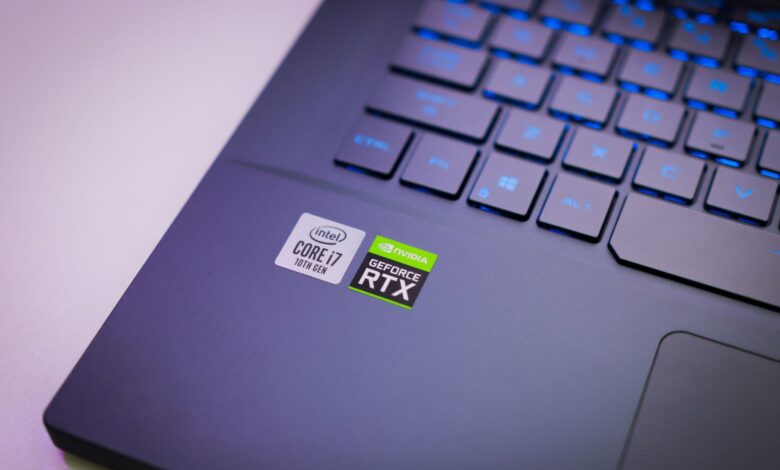
An RTX 4050 laptop is worth buying for AAA games at 1080p on high settings with DLSS turned on — but only if the specific model you’re looking at ships close to the chip’s 115W power ceiling, not the 35W low end that carries the exact same name on the box. Two laptops can both say “RTX 4050” and differ by nearly 800MHz of boost clock, because the name describes a chip, not a fixed performance level.
NVIDIA allows laptop makers to configure the RTX 4050’s Total Graphics Power — TGP — anywhere between 35W and 115W, plus up to another 25W borrowed from the CPU under Dynamic Boost. A 35W configuration and a 115W configuration use the identical AD107 chip, but the lower-power version runs a meaningfully lower voltage-frequency curve, which shows up directly as fewer frames per second in the same game at the same settings.
Why “RTX 4050” doesn’t mean one fixed performance level
Chip name and power configuration are two separate decisions a laptop maker makes independently. Notebookcheck’s RTX 4050 Laptop GPU spec page confirms the range directly: TGP can be configured between 35 and 115 watts, plus 10–25W of Dynamic Boost from the CPU, and the boost clock scales from 1605MHz at the 35W end up to 2370MHz at 115W.
That’s not a rounding difference — it’s close to a 50% boost-clock swing on paper, and real frame rates track that swing closely because the shader count and memory bus are identical across every TGP tier.
TGP explained: what determines your actual boost clock
A GPU’s boost clock is set by how much power and heat the chip is allowed to draw before it has to back off. More available power lets the voltage-frequency curve run higher before hitting its thermal or power ceiling; less available power forces an earlier, lower ceiling. NVIDIA gives the laptop manufacturer that power budget as a single configurable number — TGP — and everything else about the chip stays the same.
Stage boxes showing how the same RTX 4050 chip’s boost clock ceiling changes across three common TGP configurations
Dynamic Boost 2.0: how a laptop borrows CPU headroom for the GPU
On top of the base TGP, NVIDIA’s Dynamic Boost 2.0 lets the laptop’s firmware shift 10–25W of power from the CPU to the GPU on a frame-by-frame basis, whenever the CPU isn’t using its full budget. This is why the same 75W-TGP laptop can behave slightly differently between two games — a GPU-bound title gets more of that borrowed headroom than a CPU-bound one.
Is an RTX 4050 laptop good enough for AAA games at 1080p?
At a mid-to-high TGP configuration (75W and up), the RTX 4050 handles most current AAA titles at 1080p on high settings with DLSS Quality mode enabled, and its 80 tensor cores support DLSS 3 frame generation in supported games — a meaningful boost in CPU-bound scenes. At the 35W end of the range, the same games typically need medium settings and DLSS to hold a comparable frame rate, because the lower clock ceiling is doing measurably less work per frame.
How to find your specific laptop’s TGP before you buy
The chip name on the spec sheet almost never includes the wattage. The TGP number is usually one of these three places instead.
Checklist showing four places to confirm a laptop’s actual RTX 4050 TGP before buying
RTX 4050 laptop comparison — TGP across popular budget models
TGP varies by chassis size and cooling budget more than by brand. Larger, thicker 15–16″ chassis generally allow higher sustained TGP than the thinnest 14″ designs at a similar price.
| Configuration tier | Typical TGP | Boost clock ceiling | Best fit |
|---|---|---|---|
| Thin-and-light budget chassis | ~35–50W | ~1605–1800MHz | Esports titles, AAA at medium settings with DLSS |
| Mainstream 15″ budget chassis | ~65–80W | ~2000–2200MHz | AAA at 1080p high with DLSS Quality |
| Larger 16″+ chassis with bigger cooling | ~95–115W | ~2300–2370MHz | AAA at 1080p high/ultra, most headroom for DLSS 3 frame generation |
The Bottom Line
The RTX 4050 name tells you the chip, not the performance — TGP, which can swing from 35W to 115W on paper, tells you the real story. Check the specific model’s TGP or boost clock before comparing prices, and weight a higher-TGP 75W+ configuration over a thinner 35W chassis if AAA gaming at 1080p high settings is the priority.
Frequently Asked Questions
Is RTX 4050 enough for AAA games in 2026?
Yes, at 1080p with DLSS, provided the specific laptop runs a mid-to-high TGP configuration (75W or above). A 35W configuration of the same chip will need lower settings to hold a comparable frame rate.
How do I know my laptop’s RTX 4050 TGP?
Check NVIDIA Control Panel’s System Information page, or run HWInfo and read the GPU power limit under load — both show the real configured wattage even when the retailer listing doesn’t.
Does a higher TGP always mean a hotter, louder laptop?
Usually, yes, since a higher power budget produces more heat that the cooling system has to move — but chassis size matters too, and a well-designed 75W laptop can run cooler than a poorly cooled 50W one.
